Back to Press
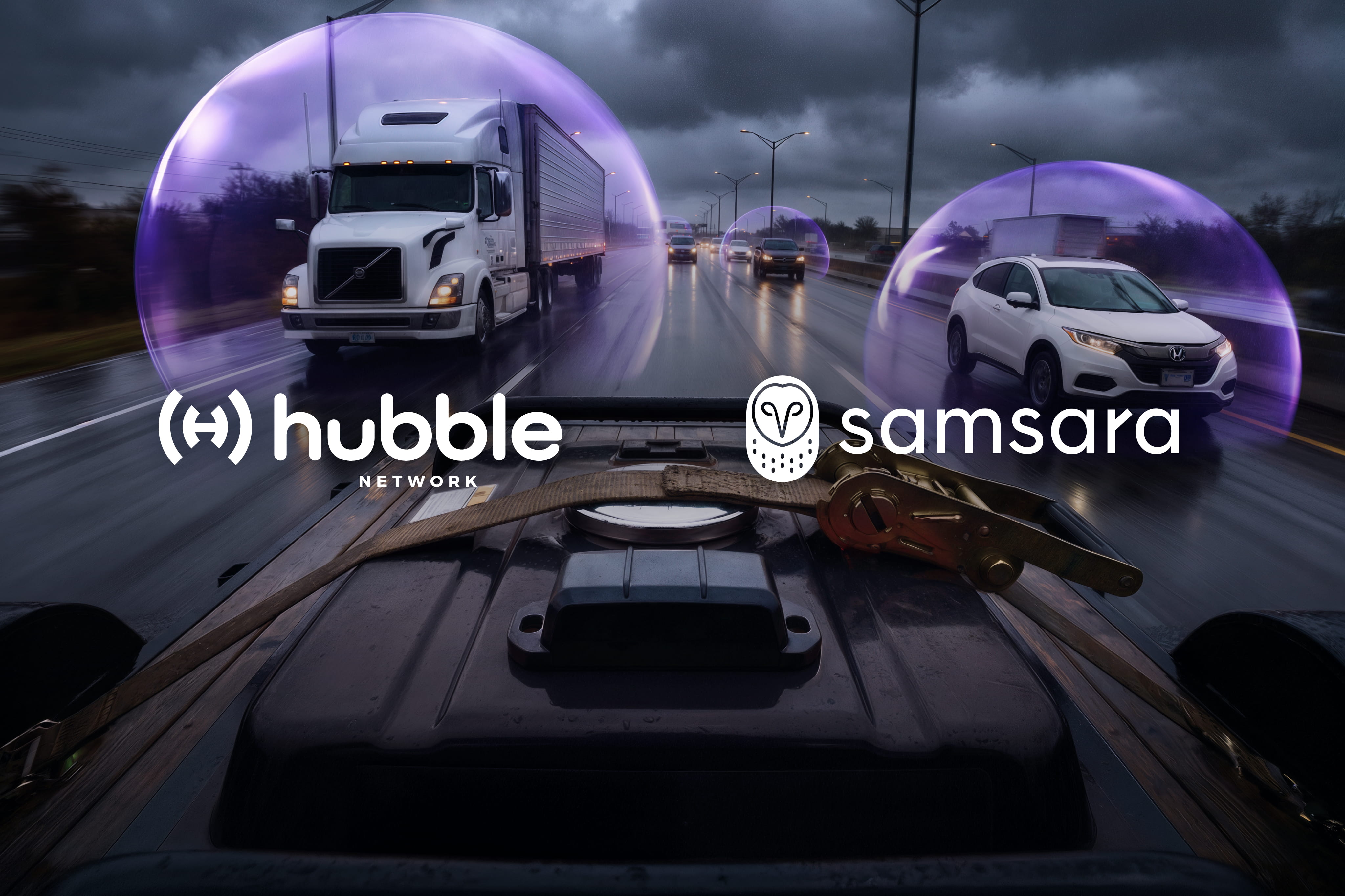
Why Samsara Chose Hubble
Asset tracking only works if the network is there when the asset moves. Together, we're raising the bar for what asset visibility can look like.
Samsara's customers operate some of the most asset-intensive businesses in the world. Construction companies manage hundreds of tools across rotating job sites. Logistics operators track shipments through multi-leg supply chains. Fleet managers are responsible for equipment that constantly moves and does not always come back on schedule.
For years, Samsara's industrial-grade Bluetooth network gave those customers something genuinely powerful: low-cost visibility of assets, powered by millions of gateways on vehicles and equipment already in the field. If an asset was near a Samsara gateway, it was found in minutes.
The problem was what happened when it wasn't.
Assets can go dark in unpredictable ways. A truck pulls off the highway and parks for the night. Equipment sits in a staging area waiting to be moved. A stolen asset ends up inside a building. Samsara's gateway network is built around its own fleet, which means visibility follows Samsara's customers, not the full universe of places an asset can travel. The moment a tagged item moved outside that footprint, the trail went cold. Not because the hardware failed. Because no single operator's network can be everywhere.
What Samsara needed
Samsara wasn't looking to replace its network. It was looking for coverage that could operate where its own infrastructure didn't; seamlessly, without adding hardware, and at a scale that could serve hundreds of thousands of asset tags across customers in every vertical.
Hubble's terrestrial network fit that requirement directly. With 90 million+ access points spanning transit corridors, dense urban areas, residential neighborhoods, and indoor spaces, Hubble's coverage isn't tied to any single fleet or deployment. It moves with the world, which means it's present in exactly the places a stolen or misplaced asset is most likely to end up.
The integration required no changes to Samsara's hardware. Their asset tags broadcast on Hubble's network natively, alongside Samsara's own. When a Samsara gateway is nearby, it picks up the signal. When it isn't, Hubble does. From the operator's perspective, the coverage is simply there.
The integration with Hubble is a natural adjacency to Samsara's existing network. Samsara's network leverages millions of gateways on assets from construction sites to highways to garbage trucks, while Hubble's network uses consumer smartphones, ensuring no lost or stolen asset can hide, even inside buildings. The best network in the business just got better, bringing unprecedented asset visibility.
— David Gal, VP of Connected Equipment, Samsara
Where things stand today
Hundreds of thousands of Samsara Asset Tags are active on Hubble's network today, across customers in construction, logistics, and fleet management, and that number is growing as Samsara rolls out its latest generation asset tags.
The question Samsara faced isn't unique to them: What do you do when your own infrastructure has edges? Adding a secondary network means choosing one that provides genuine coverage rather than duplicating what you already have, integrates without hardware changes, and scales to hundreds of thousands of devices without becoming an operational burden.
If your devices move through the real world, whether across roads, into buildings, or through areas your own network doesn't cover, that's exactly what Hubble was built for. Samsara's customers are finding assets they would have lost. Yours can too.
FREE TO START
Create a free account to prototype device connectivity on the terrestrial network. Open the sandbox in minutes.
Back to Press